
Flowers and Fruits and Vegetables Classic Stamp Series: Design Stories and Aesthetic Appreciation

In the microscopic world of stamps, the Flowers and Fruits series seems to exude a vibrant breath of life. The gentle touch of a petal and the radiance of a fruit are compressed within a single inch.
This themed stamp collection is more than just a postage voucher; it’s a condensed history of natural art. This article will take you on a journey through this classic Flowers and Fruits series, exploring the artistic conception and design inspiration behind it, and share how to achieve a high-quality collection at a lower cost through legitimate discounted USPS stamp channels.
What is the Flowers and Fruits and Vegetables Classic Stamp Series?
This stamp series is a signature work repeatedly released by postal services around the world, particularly the USPS.
Its inspiration comes from nature—the blooming of flowers, the ripening of fruits, and the colors of vegetables—all captured by the designer with microscopic brushstrokes.
For collectors, these stamps are more than just beautiful designs; they represent a globally shared theme.
These stamps combine artistry, education, and cultural continuity, making them ideal for thematic collections. And now, through discount stamp channels, you can acquire these artistically vibrant stamps at a relatively affordable price.
Design Story: Inspiration and Creation
There is a story behind every stamp, and USPS designers almost all create with the rigor of a painter and the sensitivity of a poet.
Direct sketching from nature and the still life tradition
Many stamp designs are inspired by field sketches and reinterpretations of the European still life tradition.
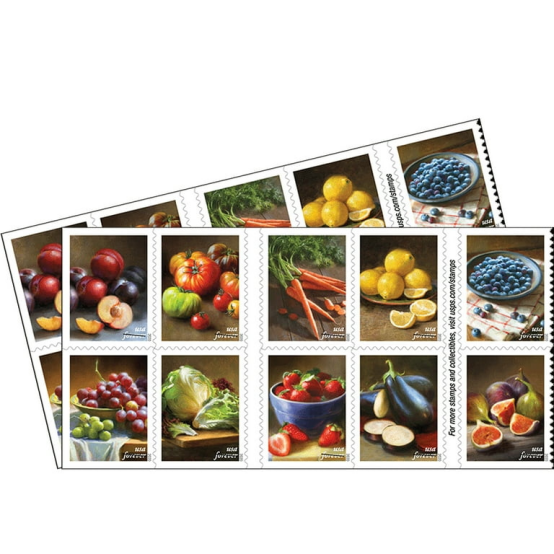
For example, the USPS’s “Fruits & Vegetables Forever” series features ten designs featuring ten different fruits and vegetables, each resembling a 17th-century Dutch still life painting. The designers utilize contrasting light and shadow to imbue everyday fruits and vegetables like tomatoes and bell peppers with painterly depth and layering.
This makes these discounted stamps, even at collector’s prices, a tangible work of art.
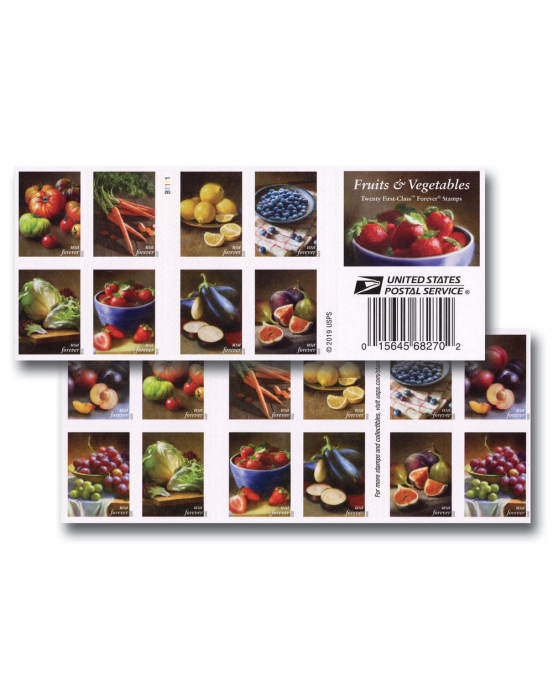
Vividness and details:
During the creative process, designers often repeatedly depict plant details—the small seeds on the surface of the strawberry, the plush edges of the petals, and the slight curve of the fruit stalk—these subtle depictions give the stamps a real sense of breath.
Integrating cultural symbols
In addition to the realistic image, the designer also cleverly incorporated cultural symbols:
In Eastern culture, peaches symbolize longevity, pomegranates signify good fortune, and lotus flowers represent purity.
In Western tradition, roses are associated with love, and lilies symbolize purity.
These connotations make stamps not just pictures but also a cultural code that transcends language.
Artistic language in Usps stamp
Exquisite printing skills
To show the beauty of nature on a one-inch square paper, the printing technology is extremely demanding.
The two commonly used processes are
Intaglio printing: The lines are deep and the ink layer is thick, showing a unique three-dimensional effect, which is particularly suitable for depicting plant textures.
Photogravure: Producing soft gradations and natural colors, it’s particularly well-suited for depicting the delicate gradations of petals and the sheen of fruit.
Many high-end stamps even combine the two techniques, achieving a dual aesthetic appeal that appeals to both the eye and the touch.
Balance of composition and color
Within the limited space, the designers create a sense of breath through close-ups and negative space.
Sometimes, they allow a flower to slant out of the frame, while other times, they leave a corner blank, evoking the fleeting moment of wind.
The colors are also meticulously chosen—true to nature while also adding a touch of artistic refinement. For example, tomatoes are made a brighter red, and green leaves a deeper shade, all for a visual impact that feels “more beautiful than life.”
When I studied these stamps, I used a magnifying glass to repeatedly examine the minute details of the engravings.
The subtle undulations and undulations of the ink lines evoked a sense of classical warmth. Even the highest-definition scans couldn’t replace the “real” feeling of holding them in my hands.
This is why, even if they come from discounted sources, this artistic quality remains irreplaceable.
Collecting Guide: Value, Authenticity, and Discounts
Key factors affecting value
Rarity: The fewer copies printed and the fewer copies left, the higher the collection value.
Condition: Intact perforations, a clean face, and intact adhesive backing are the core indicators for evaluating mint stamps (brand new).
Edition differences, such as first editions, reprints, or special printing variations, will affect the value.
A safe way to obtain authentic discount stamps
The channels we provide ensure that collectors can purchase **mint and valid** genuine USPS stamps, rather than secondary or counterfeit stamps.
Most of these stamps come from surplus or liquidation stock from American businesses.
For example, when a business closes or changes its mailing system, it may be left with a whole batch of unused Forever stamps. Through legal sourcing and manual verification, we ensure that each stamp is in working order and retains its full collectible value.
Sustainable and environmental value
This is not only an economical choice but also a responsible way to collect.
Putting unused stamps back into use not only avoids waste but also integrates collecting with environmental protection—making stamps truly “sustainable art.”
Conclusion: The continuation of art, the warmth of space
The Flower and Fruit and Vegetable stamp series represents a dialogue between nature and art and epitomizes the human aesthetic.
Even as discounted stamps, their artistic value remains radiant.
Through safe, legal, and environmentally friendly discount channels, you can more affordably collect these USPS stamps, a testament to their cultural and aesthetic value.
Perhaps, next time when you put a “Fruits & Vegetables Forever” sticker on an envelope, what you are sending is not just a letter, but a kind of aesthetic communication.
Frequently Asked Questions (FAQ)
Q1: Do discounted stamps reduce their collectible value?
No. As long as they are unused (mint) and authentic, their collectible value is the same as if they were purchased from the post office. The only difference is the more cost-effective way to obtain them.
Q2: How should I properly store stamps?
We recommend using acid-free protective bags or special stamp albums. Store stamps in a dry, cool, dark place, and avoid direct contact with the stamp surface.
Q3: Which set is the most worth collecting?
Early, smaller-run, and beautifully designed sets generally have the most potential. You can start with our special section of USPS fruit, vegetable, and flower-themed discount stamps and gradually build a complete collection.